
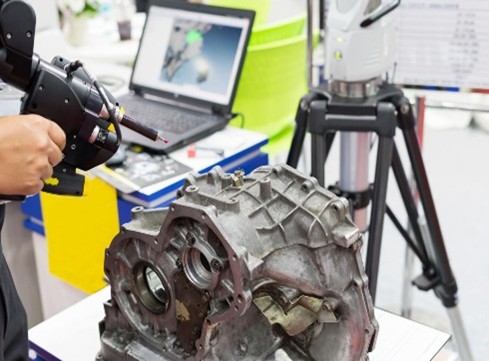
Reverse Engineering: From Physical Components to Digital Engineering Solutions
Reverse engineering, also referred to as back engineering, is a method used to analyze an existing physical component in order to understand its structure, dimensions, and functionality, and then recreate it in digital form. The component being studied can vary significantly in size and complexity—from small mechanical or electrical elements to large assemblies used in complex engineering systems. Regardless of scale, the main objective remains consistent: to generate an accurate digital model that can later be used for manufacturing, redesign, technical analysis, or integration into larger systems.
In many real-world scenarios, components remain in use long after their original design documentation has disappeared. Technical drawings may have been lost, digital CAD files may no longer exist, or the original manufacturer may no longer be operational. This creates a significant challenge when maintenance, reproduction, or improvement of these components is required. In such cases, reverse engineering becomes an essential solution. By carefully analyzing the physical object and capturing its geometry, it becomes possible to reconstruct missing design data and restore the component into a modern engineering workflow.
The reverse engineering process typically begins with the collection of precise measurements from the physical object. Traditionally, this was done manually using measuring tools, but modern workflows increasingly rely on 3D scanning technologies, which allow for rapid and highly accurate data acquisition. These technologies generate detailed digital representations such as point clouds or polygon meshes, capturing even complex geometries that would be difficult to measure manually. The collected data is then processed and transformed into usable CAD models through advanced 3D modelling techniques.
At DSC Lab, the approach to reverse engineering is always adapted to the specific characteristics of the component being analyzed. For complex geometries, 3D scanning provides an efficient and precise method for capturing surface data. However, for simpler parts, we often rely on specialized measuring instruments combined with practical engineering experience. Tools such as precision calipers, micrometers, and gauges allow us to determine dimensions directly and recreate components accurately within CAD software.
Once the geometry has been captured and reconstructed, the resulting digital model becomes a powerful engineering asset. It can be used to manufacture replacement parts, restore missing documentation, perform dimensional verification, and improve existing designs. Furthermore, digital models enable advanced simulations such as Finite Element Analysis (FEA) and Computational Fluid Dynamics (CFD), allowing performance evaluation before physical production. In this way, reverse engineering serves as a bridge between the physical and digital domains of modern engineering.
When Reverse Engineering Is Needed
Reverse engineering is widely applied across industries where there is a need to analyze, reproduce, or improve existing products, systems, or individual components. Its importance becomes particularly evident in situations where original design data is missing, outdated, or insufficient for current requirements. By extracting accurate geometric and functional information directly from physical objects, it becomes possible to understand how a product was designed and how it behaves under real operating conditions.
This approach supports not only the replication of parts but also their optimization and adaptation to new applications. It enables companies to extend the lifespan of equipment, reduce downtime, and integrate modern technologies into legacy systems. As a result, reverse engineering has become a key process in engineering, manufacturing, and product development.
In the automotive industry, reverse engineering is commonly used to analyze, reproduce, and enhance existing components. Through the use of 3D scanning and CAD modelling, precise surface data can be captured and used to improve performance characteristics such as aerodynamics, structural strength, and weight distribution. It is particularly valuable for producing spare parts for discontinued or older vehicles where original components are no longer available. Additionally, it supports the development of aftermarket components that must fit precisely within existing systems.
In the manufacturing sector, reverse engineering plays a crucial role in process optimization and product development. It enables the accurate replication of components, identification of defects, and analysis of tolerances. By understanding how a part is designed and manufactured, companies can reduce material waste, improve production efficiency, and shorten development cycles. It is also widely used to update tooling and reproduce parts that are no longer supplied by original manufacturers.
In the aerospace industry, where safety and precision are critical, reverse engineering is applied to analyze and reconstruct complex components such as turbine blades and structural elements. By capturing accurate geometry through 3D scanning, it becomes possible to detect wear, hidden defects, and structural weaknesses that may impact performance. This contributes to improved maintenance, increased reliability, and compliance with strict safety regulations.
In the medical field, reverse engineering is used to develop customized implants and prosthetics tailored to individual patients. By combining anatomical data with precise 3D modelling, patient-specific solutions can be created that improve comfort, functionality, and long-term outcomes. It also supports the reconstruction of anatomical structures in cases involving trauma or complex medical conditions.
Across all these industries, reverse engineering provides a practical and reliable solution for addressing real-world challenges where traditional design data is unavailable or incomplete.
Scan-to-CAD: Transforming Physical Objects into Digital Models
A fundamental element of modern reverse engineering is the Scan-to-CAD process, which enables the transformation of physical objects into accurate and editable digital models. This process integrates 3D scanning technologies with CAD systems, allowing a seamless transition from physical geometry to digital engineering data.
The process begins with data acquisition, where a 3D scanner captures the geometry of a physical object by projecting laser or structured light onto its surface. The reflected signals are recorded and converted into spatial coordinates, generating a dense dataset composed of thousands or millions of points. This dataset forms a point cloud or polygon mesh that accurately represents the object’s shape, dimensions, and surface characteristics.
Once the data is captured, it is processed within specialized scanning software. This stage involves aligning multiple scans, adjusting resolution, and merging the data into a unified model. Since raw scan data often contains noise, gaps, or inconsistencies, additional processing is required to refine the mesh. This includes operations such as noise reduction, hole filling, smoothing, and alignment correction.
The next step is the conversion of the processed mesh into a parametric CAD model. At DSC Lab, this stage is considered one of the most critical parts of the workflow. It requires not only technical accuracy but also a deep understanding of engineering principles and manufacturing requirements. The geometry is reconstructed using parametric features such as sketches, surfaces, and solid operations, making the model fully editable and suitable for engineering applications.
Compared to traditional measurement techniques, the Scan-to-CAD approach offers significant advantages in terms of speed, accuracy, and repeatability. Complex geometries that would be extremely difficult to measure manually can be captured quickly and converted into precise digital models. This makes Scan-to-CAD an essential tool in modern reverse engineering workflows.
Reverse Engineering Workflow
A successful reverse engineering project depends on a well-organized and carefully executed workflow. The Scan-to-CAD methodology provides a structured path that ensures accuracy, efficiency, and reliability throughout the entire process.
The workflow begins with the preparation of the physical component. Proper preparation is essential to ensure high-quality scan data. This includes cleaning the surface, removing contaminants, applying matte coatings when necessary, securing the object, and positioning it correctly for optimal scanning.
Once the object is prepared, the next phase involves capturing its geometry using a 3D scanner. The object is scanned from multiple angles to ensure complete coverage, including complex and hidden areas. The collected data is then merged into a unified dataset, forming a detailed digital representation.
The following stage focuses on processing and optimizing the scan data. This includes removing noise, repairing missing geometry, optimizing mesh density, and aligning the model within a coordinate system. These steps are essential to ensure that the data is clean, accurate, and ready for CAD reconstruction.
In the final stage, the processed data is imported into a CAD environment. The geometry is reconstructed into a parametric model using engineering features, enabling full control over the design. This model can then be used for manufacturing, analysis, or further development.
By following this structured workflow, reverse engineering becomes a reliable and repeatable process that delivers consistent and high-quality results.
Applications of Reverse Engineering in Manufacturing
In manufacturing, reverse engineering serves as a critical link between physical components and digital production processes. It supports a wide range of applications, including casting, machining, tooling, and product optimization.
In casting and mold development, reverse engineering enables the creation of accurate digital models that can be used to design molds and patterns. This is particularly valuable when reproducing legacy components where original tooling is no longer available. By using 3D scanning and 3D modelling, we at DSC Lab ensure that the final cast components maintain both dimensional accuracy and visual consistency with the original design. Additionally, digital models can be used for simulation, helping to optimize material flow and reduce defects.
In machining and CNC manufacturing, reverse engineering allows the production of precise components directly from digital models. Once a part is digitized and reconstructed, it can be used to generate CNC toolpaths for milling, turning, or drilling. This is especially useful for producing spare parts or restoring damaged components. By combining accurate scanning with advanced modelling, we ensure that the final parts meet strict tolerances and integrate seamlessly into existing systems.
Reverse engineering also plays a key role in tooling and fixture development. Tools such as molds, dies, and jigs often need to be recreated or modified over time. By reconstructing their geometry digitally, it becomes possible to improve their design and adapt them to modern production requirements. This supports faster production cycles and increased flexibility.
Beyond reproduction, reverse engineering contributes to product improvement and optimization. By analyzing existing components, inefficiencies can be identified and corrected. This leads to better performance, reduced material usage, and lower production costs. Additionally, digital models can be stored as part of a digital archive, preserving valuable design data for future use.
Challenges and Best Practices
Despite its advantages, reverse engineering presents several challenges that must be carefully managed. One of the most common challenges is capturing accurate geometry from worn or damaged parts. Over time, components may deform, corrode, or lose material, making it difficult to determine the original design intent. In such cases, we at DSC Lab rely not only on scan data but also on engineering judgment and experience.
Another challenge involves surface properties that can affect scanning accuracy. Reflective, transparent, or dark surfaces can introduce noise or incomplete data. Proper preparation and the selection of appropriate scanning techniques are essential to overcome these limitations.
The transition from scan data to a usable CAD model is also a complex process that requires precision and expertise. Raw scan data is not directly suitable for manufacturing, and converting it into a parametric model requires careful planning and execution.
Best practices include defining the project requirements in advance, balancing accuracy with efficiency, and validating the final model against the original component. Clear communication and verification are essential to ensure that the final result meets both technical and practical expectations.
Conclusion
Reverse engineering has become an essential component of modern engineering and manufacturing, combining traditional problem-solving approaches with advanced digital technologies such as 3D scanning and 3D modelling. It provides a practical and effective solution in situations where design data is missing, outdated, or incomplete, enabling physical components to be transformed into accurate and functional digital models.
However, its true value extends beyond simple reproduction. Reverse engineering enables continuous improvement, supports innovation, and allows legacy components to be adapted to modern production requirements. It reduces development time, minimizes costs, and improves overall efficiency in engineering workflows.
At DSC Lab, reverse engineering is approached not only as a technical process but also as an engineering discipline that requires precision, experience, and a deep understanding of manufacturing. Each project involves careful interpretation of physical data to ensure that the final result is both accurate and suitable for real-world applications.
As industries continue to move toward digitalization and automation, reverse engineering will play an increasingly important role in bridging the gap between physical and digital environments. It enables companies to remain competitive, flexible, and innovative, ensuring that both existing and future products can be developed, improved, and maintained with maximum efficiency.